About Western Migrations
Seasonal migrations are vital for sustaining big-game populations across the Western United States, enabling ungulates to access and track favorable forage or avoid harsh winter conditions. But across the West, roads, fences, and other human developments can impede movement and threaten the long-term persistence of ungulate herds that rely on migration. These challenges, along with the scale and transboundary nature of migration, has resulted in collaborative opportunities to identify, maintain and improve migration corridors across the Western United States.
Recognizing that robust big-game populations contribute greatly to the economy and well-being of communities across the West, the Department of Interior (DOI) issued Secretarial Order 3362 "Improving Habitat Quality in Western Big Game Winter Range and Migration Corridors" in 2018. The order directed DOI agencies to work in close collaboration with state wildlife management agencies to conduct habitat improvement work on DOI-managed lands and support big-game migration in a way that recognizes state authority to conserve and manage big-game species.

Department of the Interior Secretary Zinke signing SO 3362.
Photo credit: The Salt Lake Tribune
The Secretarial Order also directed the U.S. Geological Survey (USGS) to collaborate with state wildlife agencies to develop maps and tools related to elk, deer, and pronghorn migration and land use. In response, USGS formed the Corridor Mapping Team comprised of federal and university scientists and State and Tribal wildlife experts, to map migrations and make the information publicly available. While USGS provides the structure and coordination of the CMT, participating Western States and Tribes provide the backbone of the effort by bringing decades of experience with wildlife habitats and wildlife tracking data collection. The result of this partnership is a growing inventory of mapped ungulate migrations across the Western States.
For questions regarding this collaborative program, please reach out to USGS researchers Matt Kauffman ([email protected]) or Blake Lowrey ([email protected]).
Who We Are
The Corridor Mapping Team (CMT) is a partnership among State agencies, regional and Federal partners, and an expanding number of Tribal nations that work collaboratively to implement a unified mapping approach for ungulate migrations throughout the Western United States. The CMT’s highly collaborative approach and regular meetings help foster a community of practice and maintain an open dialog among the many partners. For example, coordination of the CMT has helped facilitate transboundary mapping of ungulate migrations across many western states and strengthened communication among States and Tribes. The CMT members consist of wildlife biologists from participating States and Tribes, cartographers, and spatial analysts, although these roles can overlap.
Arizona: Partners from the Arizona Game and Fish Department (AZGFD) have participated on the CMT since its inception in 2018 and have published corridor maps for multiple ungulate taxa. Notably, AZGFD and other partners are using migration maps of mule deer and pronghorn to inform renewable energy development on private lands in northern Arizona south of Grand Canyon National Park. The Mule Deer Foundation has been an important partner in Arizona and has helped to fund agency positions focused on big game migration and conservation.
- Jeff Gagnon, Wildlife Specialist Regional Supervisor, [email protected]
- Abigail Lenzini, Cooperative Migration Biologist, [email protected]
- Brianna Russo, Wildlife Specialist, [email protected]
- Scott Sprague, Project Manager/Road Ecologist, [email protected]
California: California Department of Fish and Wildlife (CDFW) has participated on the CMT since 2021 and the publication of Volume 2, which included multiple California elk and mule deer herds. The state continues to integrate migration maps into statewide conservation and planning tools, such as the Terrestrial Wildlife Connectivity Barriers Map. In addition to the herds included in the USGS report series, CDFW has analyzed and mapped many other ungulate herds across California, which can be found in the Ungulate Migration Viewer of CDFW’s connectivity webpage.
- Evan Greenspan, Project Manager/Ecological Modeler, [email protected]
- Brian Leo, Statewide Deer Coordinator, [email protected]
- Brent Wolf, Elk and Pronghorn Coordinator, [email protected]
Colorado: Colorado Parks and Wildlife (CPW) has participated on the CMT since 2023 and the publication of Volume 4, which included Colorado elk and mule deer herds. In addition to the maps published in the USGS report series, CPW has made available its Species Activity Map (SAM) data layers, which contain species-specific statewide migration maps for elk, pronghorn, and mule deer. Additionally, CPW continues to incorporate the mapped migrations into their Wildlife Migration and Movement initiatives.
- Michelle Cowardin, Wildlife Movement Coordinator, [email protected]
- Michelle Flenner, GIS Specialist, [email protected]
- Andy Holland, Big Game Manager, [email protected]
- Nick Jaffe, Spatial Ecologist, [email protected]
Idaho: Idaho Department of Fish and Game (IDFG) is a long-standing partner of the CMT and has mapped numerous herds in all volumes of the USGS report series, totaling nearly 60 herds in Volumes 1-5.
- Scott Bergen, Senior Wildlife Research Biologist, [email protected]
- Matt Mumma, Wildlife Research Manager, [email protected]
- Rob Ritson, Associate Research Scientist, [email protected]
Montana: Montana Fish Wildlife and Parks (MTFWP) has mapped many ungulate migrations across Big Sky Country, which are not included in the USGS report series but shared through MTFWP-led efforts. In addition to staff from MTFWP, Blake Lowrey, the co-lead of the CMT for USGS is also based in Bozeman, MT at the Northern Rocky Mountain Science Center.
- Justin Gude, Research Administrator, [email protected]
- Blake Lowrey, Research Ecologist, [email protected]
- Kelly Profitt, Wildlife Research Biologist, [email protected]
Navajo Nation: Biologists working for the Navajo Nation have been important partners on the CMT and have included multiple mule deer herds starting in Volume 3 of the report series.
- Jamie Begay, Graduate Student, [email protected]
- Jess Fort, Wildlife Biologist, [email protected]
- Tatjana Woody, Wildlife Biologist, [email protected]
Native American Fish and Wildlife Society: As an NGO that represents all Tribes, the Native American Fish and Wildlife Society (NAFWS) has been a critical partner to help broaden Tribal engagement and map ungulate migrations on Tribal lands.
- Emily Hagler, Wildlife Biologist, [email protected]
- Shailyn Miller, Wildlife Corridors Coordinator, [email protected]
Nevada: The Nevada Department of Wildlife (NDOW) was an early partner of the CMT and included multiple mule deer herds in the first report volume. In 2025, the newly established Nevada Cooperative Fish and Wildlife Research Unit at the University of Nevada, Reno helped to further build capacity across the state.
- Jeff Falke, Unit Leader, [email protected]
- Brian Folt, Assistant Unit Leader, [email protected]
- Nathan Jackson, Postdoctoral Scholar, [email protected]
- Cody McKee, Wildlife Staff Specialist, [email protected]
- Cody Schroeder, Wildlife Staff Specialist, [email protected]
New Mexico: Partners in New Mexico include the New Mexico Department of Game and Fish (NMDGF) as well as the New Mexico Cooperative Fish and Wildlife Research Unit at New Mexico State University. The entities employ a collaborative approach to mapping ungulate migrations and have participated in the CMT since 2021 and the publication of Volume 2.
- Jimmy Cain, Unit Leader, [email protected]
- Orrin Duvuvuei, Deer Program Manager, [email protected]
- Joanna Ennis, Graduate Student, [email protected]
- Craig Reddell, GIS Analyst, [email protected]
- Nicole Tatman, Big Game Project Manager, [email protected]
Oregon: Partners in Oregon include the Oregon Department of Fish and Wildlife (ODFW) and the Oregon Cooperative Fish and Wildlife Research Unit at Oregon State University. Thus far collaborators in Oregon have focused on mapping mule deer migrations in the eastern part of the state and have been involved with the CMT since 2023 and the publication of Volume 4.
- Katie Dugger, Assistant Unit Leader, [email protected]
- Valerie Hinojoza-Rood, Faculty Research Assistant, [email protected]
- Rachel Wheat, Wildlife Connectivity Coordinator, [email protected]
- Don Whittaker, Ungulate Species Coordinator, [email protected]
Utah: Partners in Utah stem from the Utah Division of Wildlife Resources (UDWR). UDWR has included Utah mule deer herds in the publication starting with volume 2. In addition to the herds included in the USGS report series, DWR has mapped many other mule deer herds, all of which can be explored through their state-led Wildlife Migration Initiative.
- Amy Ehrhart, Wildlife Migration Data Specialist, [email protected]
- Makeda Hanson, Wildlife Migration Initiative Coordinator, [email protected]
Washington: Partners in Washington include the Washington Department of Fish and Wildlife (WDFW), who have been involved since Volume 2 of the USGS report series.
- Samantha Bundick, Ungulate Specialist, [email protected]
- Brendan Oates, Ungulate Specialist, [email protected]
Wyoming: Partners in Wyoming are diverse and include the Wyoming Game and Fish Department (WGFD), the USGS Wyoming Cooperative Fish and Wildlife Research Unit (WCFWRU) and other departments at the University of Wyoming, partners working on the Wind River Indian Reservation, and WEST Inc., a private consulting firm. In addition to mapping migrations within Wyoming, the WCFWRU is the administrative lead for the national migration mapping effort.
- Kevin Blecha, Graduate Student, [email protected]
- Martin Hicks, WGFD Deputy, [email protected]
- Pat Hnilicka, Supervisory Fish and Wildlife Biologist, [email protected]
- Andrew Jakes, Sr. Research Scientist, [email protected]
- Matt Kauffman, Unit Leader, [email protected]
- Jaron Kolek, Associate Research Scientist, [email protected]
- Jenny McKee, Sr. Research Scientist, [email protected]
- Jerod Merkle, Associate Professor, [email protected]
- Jill Randall, WGFD Migration Coordinator, [email protected]
- Hall Sawyer, Principal Biologist, [email protected]
Cartographic Team:
The cartographic hub of the CMT is stationed at the InfoGraphics Lab at the University of Oregon.
- Joanna Merson, Web Cartographer and Project Manager, [email protected]
- Erik Steiner, Director of InfoGraphics Lab, [email protected]
- Clare Otcasek, Research Assistant, [email protected]
- Owen Ferguson, Research Assistant, [email protected]
- Alethea Steingisser, Cartographic Production Manager, [email protected]
- Peyton Carl, Project Manager and Research Assistant, [email protected]
- James Meacham, Cartographic Editor Emeritus, [email protected]
Core Analytics:
The core analytics team of the CMT consists of individuals from multiple States and agencies who work collaboratively to develop and implement a unified mapping approach.
- Josh Gage, Geospatial Software Developer, [email protected]
- Emily Gelzer, Western Wildlife Research Collective, [email protected]
- Jaron Kolek, Associate Research Scientist, [email protected]
- Blake Lowrey, Research Ecologist, [email protected]
- Jenny McKee, Research Scientist, [email protected]
- Jerod Merkle, Associate Professor, [email protected]
- Hall Sawyer, Principal Biologist, [email protected]
OWNERSHIP AND ACCESS
Data Ownership
The mapping layers available on this website come primarily from State and Tribal wildlife management agencies, who have a statutory responsibility to manage and conserve big game populations, including bison, elk, bighorn sheep, mule deer, and pronghorn. For decades, these agencies have deployed GPS collars on big game animals and collected tracking data to help identify the key habitats the herds require. The resulting GPS data are used by these agencies to provide a more complete understanding of the year-round habitat needs of the wildlife they manage, including seasonal ranges and migratory routes.
Many of the mapping layers shown here have been sourced from the USGS ScienceBase platform where participating States and Tribes have chosen to archive their datasets in association with the published reports. In addition, several States host migration files on their own websites, which this platform accesses to provide users with the most up-to-date mapping layers.
Available Migration Maps
The migration mapping layers provided on this website are what we refer to as derived mapping layers. No raw GPS location data are available for download. Instead, each mapping product is created through an analytical process that begins with the original tracking data collected by the wildlife agencies. Typically, analysts use net-squared displacement to identify the start and end points of a migration. Methods such as Brownian bridge movement modeling or the line-buffer method are then applied to delineate individual movement paths, and ultimately, to build a population-level migration corridor. Most often, agencies categorize the resulting population-level corridor into high-, medium-, and low-use corridors, with many datasets also including delineation of key stopover habitats. Typically, these analyses are conducted by spatial analysts working at, or in collaboration with, participating State or Tribal wildlife agencies. In some cases, only the migration lines or routes are shown and available to download.
How to Access Mapping Layers
There are multiple ways to access mapped migrations on this site:
- Explore by Individual Herd. The website is organized around individual big game herds. You can navigate the map, zoom into a region of interest, and select a particular herd to learn more. Once on the page for a specific herd, you can download the available mapping layers using the button located on the lower-left panel. These herd-level pages also provide links to the corresponding report sections from the USGS Ungulate Migrations of the Western United States series where the herd’s corridor was originally published. In instances where a more comprehensive update was published in a later report volume, the derived mapping layers from the most recent report publication are viewable through this site.
- Use the Query Tool. For more targeted searches, the query tool allows you to filter migrations by criteria such as species, state, or land ownership. For example, you might request all migrations that overlap national parks or all mule deer migrations occurring in California. When a query is completed, a customized download will be available containing just the selected migrations.
Resources
USGS Report Series
A key goal of the Corridor Mapping Team is to make the mapped migrations available for use by managers, conservationists and other stakeholders. To this end, mapped migrations are published in an annual USGS report series entitled Ungulate Migrations of the Western United States, which are included below. Each report has a link (below) to the pdf, html, and the ScienceBase release of map files.
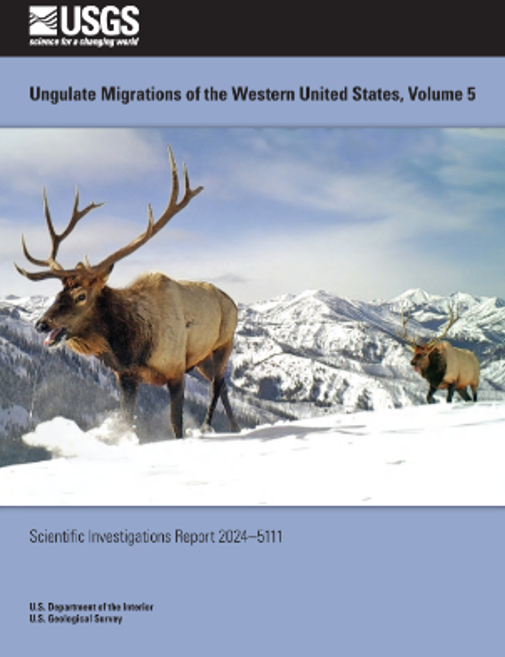
Ungulate Migrations of the Western United States, Volume 5
Document: Report (89.9 MB pdf), HTML, XML, ScienceBase Data Release
Ungulate Migrations of the Western United States, Volume 4
Document: Report (89.9 MB pdf), HTML, XML, ScienceBase Data Release
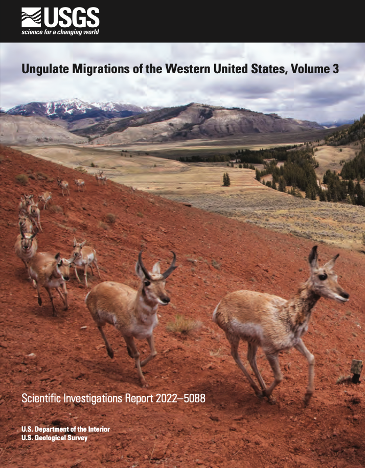
Ungulate Migrations of the Western United States, Volume 3
Document: Report (89.9 MB pdf), HTML, XML, ScienceBase Data Release
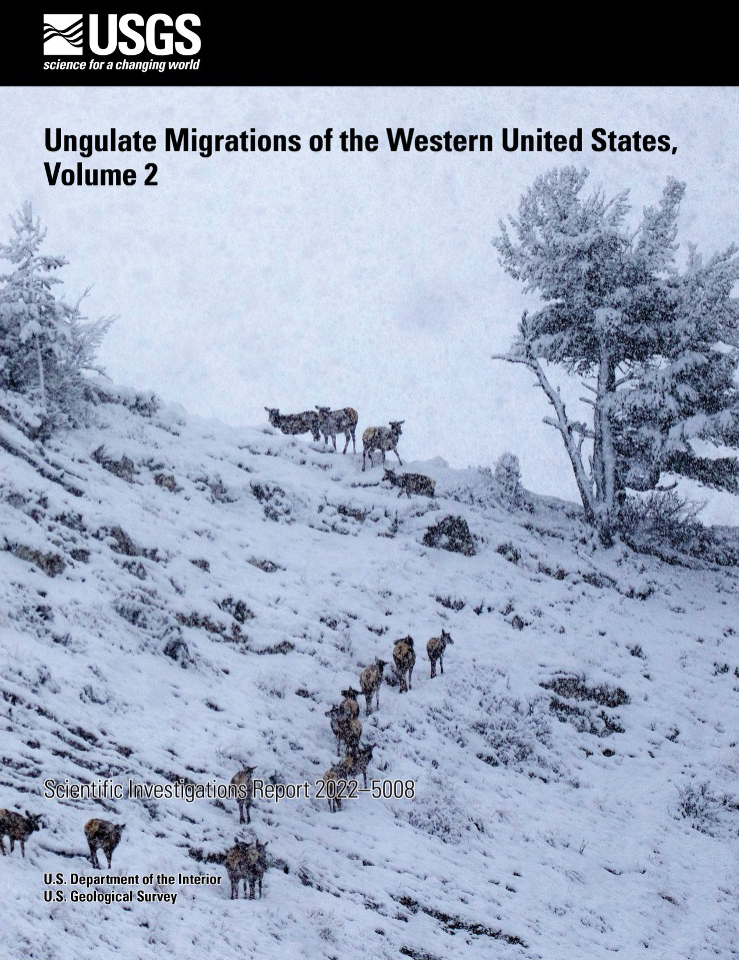
Ungulate Migrations of the Western United States, Volume 2
Document: Report (89.9 MB pdf), ScienceBase Data Release
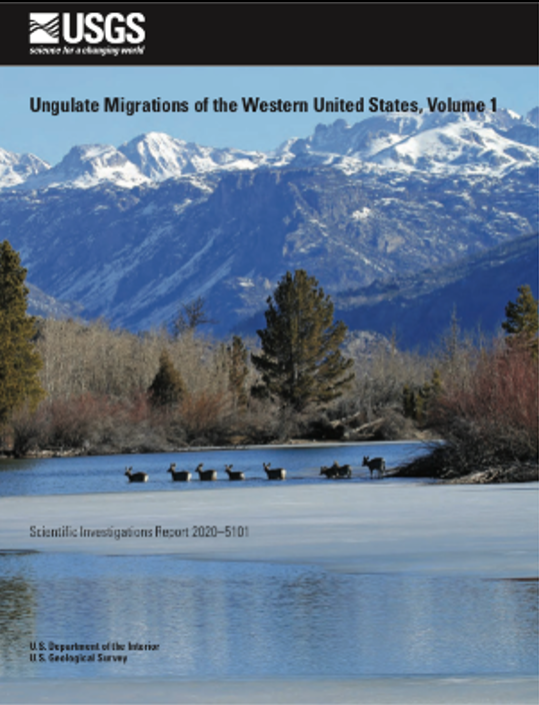
Ungulate Migrations of the Western United States, Volume 1
Document: Report (89.9 MB pdf), ScienceBase Data Release
Migration Mapper
Understanding and mapping the seasonal habitats that the herds require is critical to wildlife conservation and management. Maps of animal movement are particularly important for efforts focused on migratory wildlife, as migratory animals rely on connected, seasonal habitats that span large landscapes. Migration Mapper™ is a free application designed for researchers, biologists, and managers, to analyze fine-scale GPS collar data collected from migratory ungulates or other migratory species. The app was developed by core members of the CMT and is continually maintained and updated by our group.
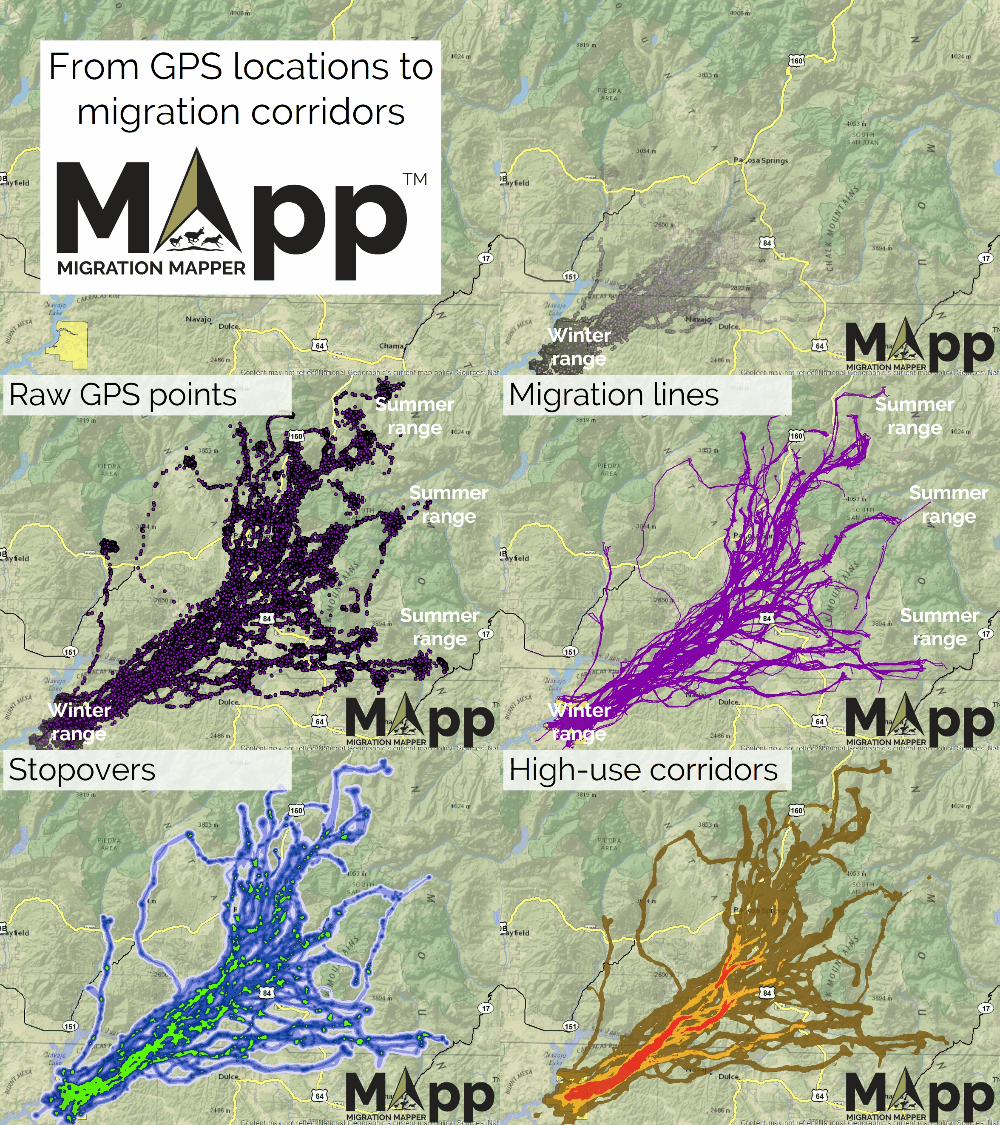
The most recent version of Migration Mapper can be downloaded here.
The Migration Mapper User Guide is located here.
There are helpful instructional videos for Migration Mapper located here.
We are always looking for ways to make migration mapper more powerful and user friendly. Please reach out if you have suggestion for improvements ([email protected]).
Additional Publications
Below are the core peer-reviewed publications that inform the methods and analytics of the CMT:
- Horne, J. S., E. O. Garton, S. M. Krone, and J. S. Lewis. 2007. Analyzing animal movements using Brownian bridges. Ecology 88:2354–2363.
- Sawyer, H., M. J. Kauffman, R. M. Nielson, and J. S. Horne. 2009. Identifying and prioritizing ungulate migration routes for landscape-level conservation. Ecological Applications 19:2016–2025.
- Bunnefeld, N., L. Börger, B. van Moorter, C. M. Rolandsen, H. Dettki, E. J. Solberg, and G. Ericsson. 2011. A model-driven approach to quantify migration patterns: individual, regional and yearly differences. Journal of Animal Ecology 80:466–476.
- Merkle, J. A., J. Gage, H. Sawyer, B. Lowrey, and M. J. Kauffman. 2022. Migration Mapper: Identifying movement corridors and seasonal ranges for large-mammal conservation. Methods in Ecology and Evolution 13:1–7.
- Merkle, J. A., B. Lowrey, C. F. Wallace, L. E. Hall, L. Wilde, M. J. Kauffman, and H. Sawyer. 2023. Conserving habitat for migratory ungulates: How wide is a migration corridor? Journal of Applied Ecology 60:1763–1770.
- McKee, J. L., J. Fattebert, E. O. Aikens, J. Berg, S. Bergen, E. K. Cole, H. E. Copeland, A. B. Courtemanch, S. Dewey, M. Hurley, B. Lowrey, J. A. Merkle, A. D. Middleton, T. A. Nuñez, H. Sawyer, and M. J. Kauffman. 2024. Estimating ungulate migration corridors from sparse movement data. Ecosphere 15:e4983.
- Gelzer, E. R., J. A. Becker, S. P. H. Dwinnell, G. L. Fralick, L. E. Hall, R. C. Kaiser, M. J. Kauffman, T. N. LaSharr, K. L. Monteith, A. C. Ortega, J. E. Randall, H. Sawyer, M. Thonhoff, and J. A. Merkle. 2025. How sampling design of GPS collar deployment influences consistency of mapped migration corridors over time. Journal of Wildlife Management 89: e70009.
RELATED PROGRAMS
SPORTSMANS SPONSOR
Rocky Mountain Elk Foundation
 Now in its fifth decade of Conserving America’s Big Game,™ RMEF® will extend its impact on habitat and public land access to 10 million acres by 2030. RMEF conserves and enhances habitat for elk and all big game, opens and improves access for hunting and other outdoor recreation, conducts science-based wildlife research and ensures the future of our hunting heritage through advocacy, outreach and education.
Conserving migration corridors and habitat connectivity is a mission priority for RMEF, as scientific research repeatedly demonstrates their necessity in maintaining healthy big game populations. Carefully mapped migration data helps RMEF identify critical range where land projects, habitat stewardship work and the application of best management practices, such as wildlife-friendly fencing, will safeguard or improve migration corridors vital to elk, mule deer, pronghorns and other ungulates. Harnessing this data has enabled RMEF and its partners to complete thousands of projects that have a positive and lasting effect on landscapes across the West where big game migrations occur.
RMEF, through its national grant program, awards financial support to the USGS Migrations Lab and other agencies so that detailed data on how ungulates move across the landscape and use seasonal ranges continues to be available. Such data is an essential element in RMEF’s on-the-ground commitment to the long-term sustainability of some of our most iconic big game species.
Partners like USGS, along with more than 1 million members, volunteers and supporters nationwide, help RMEF further its mission. Find out more and join the movement at rmef.org or 800-CALL-ELK.
RELATED PROGRAMS
Following the signing of Secretarial Order (SO) 3362, many agencies developed efforts to work on migrations and enhance the underlying habitats they require through collaborative partnerships.
Bureau of Land Management (BLM)
As a key federal agency responsible for management of 245 million acres of public land, most of it in the American West, the Bureau of Land Management (BLM) is critical to implementation of SO 3362. The BLM contributes to this work through numerous efforts to enhance migration habitat and to include mapped migrations in their land-use planning where appropriate. They also contribute to the NFWF Western Big Game Seasonal Habitat and Migration Corridors Fund. View an update of BLM’s latest accomplishments.
Federal Highway Administration (FHWA)
The 2021 Infrastructure Investment and Jobs Act created a Wildlife Crossings Pilot Program for the first time, authorizing $350 million in funding through 2026. This is a competitive grant program with the goal of reducing wildlife vehicle collisions while also improving wildlife connectivity relative to roadways. The program is implemented by the Federal Highway Administration under the U.S. Department of Transportation.
National Fish and Wildlife Foundation (NFWF)
Implementation of SO 3362 resulted in the creation of a migration habitat fund established and managed under the National Fish and Wildlife Foundation. The Western Big Game Seasonal Habitat and Migration Corridors Fund seeks to conserve migration corridors (and winter range) to enhance big game populations and sustain migratory behavior. Since its conception in 2019, the habitat fund has leveraged $88.9 million to support 86 projects across the West that seek to i) protect private land from fragmentation, ii) restore and enhance migratory habitats, iii) improve grazing management, and iv)remove or improve fencing to wildlife-friendly standards to increase landscape connectivity.
National Park Service (NPS)
The National Park Service (NPS) is charged with preserving core protected areas throughout the American West and has been an active participant on SO 3362 coordination. The NPS has directed energy and funding investments at understanding and maintaining connectivity beyond NPS boundaries, restoring native sagebrush and grassland communities inside parks and reducing wildlife vehicle collisions in partnership with States. Park Service activities around migration and connectivity were outlined in this recent Policy Memo from March 2025.
Native American Fish & Wildlife Society (NAFWS)
The Native American Fish & Wildlife Society is a national non-profit organization that serves as an informative communication network among tribal, federal, and state fish and wildlife management entities. NAFWS has been an active participant on SO 3362 coordination and helped to increase communication with western Tribal groups and further their involvement in ungulate mapping across the western U.S. NAFWS participation with the CMT and leadership with regional Tribes through their Habitat Connectivity Initiatives has greatly expanded the reach of work surrounding SO 3362.
U.S. Department of Agriculture (USDA)
Many migrations are underpinned by “working lands”, large private land holding that remain intact and provide wildlife habitat that often connects larger swaths of public land. In recognition of this, the Natural Resource Conservation Service created the USDA Migratory Big Game Initiative, which grew out of a pilot program in Wyoming that started in 2022. The goal of the initiative is to support voluntary conservation of private working lands to support migratory big game populations.
U.S. Fish and Wildlife Service (USFWS)
Since the signing of SO 3362, the U.S. Fish and Wildlife Service has led implementation of the SO through coordination with WAFWA and participating State and Federal agencies. The SO 3362 coordinator, supported by the USFWS, has worked closely with the directors of the western State wildlife management agencies on the development of State Action Plans in addition to most other activities associated with the broader effort. View an update on USFWS work on SO 3362.
Western Association of Fish and Wildlife Agencies (WAFWA)
From the inception of SO 3362, the Western Association of Fish and Wildlife Agencies has been a key partner representing and coordinating the interests of the western State wildlife agencies. The WAFWA maintains a web page on SO 3362, which is a clearinghouse for lots of information relative to the effort. In addition, WAFWA created the Wildlife Migration and Movement Working Group in 2019 to bring greater focus and coordination to this issue. View the activities of the WMMWG.
Welcome to Western Migrations
Coordinated by

With support from
This project is a collaboration among the following partners: